
A crystal artifact at the intersection of science, symbolism, and human exploration.
A small sphere with a planetary biography
On 4 February 2004, a compact, heavy crystal sphere left an ordinary workshop and began an extraordinary journey. It was created not as an ornament, but as a talisman for future missions—missions that would span the skies, the polar ice caps, the deep ocean, and some of the most remote places on Earth.
It was given an ambitious name:
“The Heart of the World.”
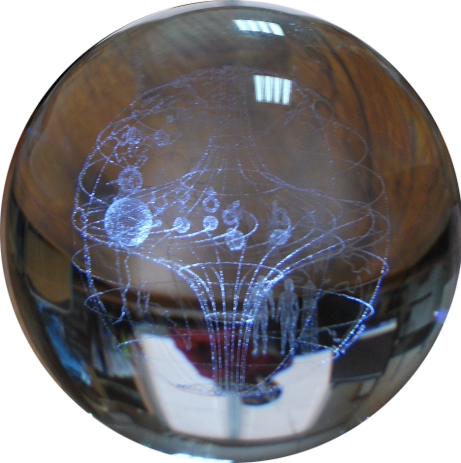
At first glance, it is simply a perfectly polished crystal sphere. But inside, one discovers far more than decorative engraving. It is an attempt to compress the Universe into a transparent volume, and at the same time to remind us that human life, love, and knowledge are inseparable from the cosmos.
The interior of the Heart of the World is formed by precision micro-laser engraving. Its core contains a carefully designed composition:
Hydrogen is the first element born after the Big Bang—simple, ubiquitous, and the primary building block of stars. By placing the hydrogen atom inside the artifact, its creator expresses a clear idea: “Life on Earth is made of the same substance as the stars.”
The presence of Woman and Man reminds us that humanity is part of the cosmic narrative, while the continents and oceans transform the sphere into both a globe and a metaphor.
Throughout history, the farther human beings traveled—from oceans to poles, from skies to outer space—the stronger their need became for a symbol to take with them:
Such objects communicate a message:
science is done by human beings—not machines alone.
The Heart of the World continues this tradition but takes it further. It is currently the only known cultural artifact with authentic originals placed at both poles of our planet.
One original crystal sphere is preserved at the museum of the Amundsen–Scott South Pole Station, located at approximately 2,835 meters above sea level, atop the vast Antarctic ice sheet.
Beneath the station lie several additional kilometers of ice; in some areas, the total thickness of the Antarctic sheet exceeds 4.5–4.7 km.
This means the artifact rests at an effective altitude of more than five kilometers above bedrock—a silent witness at the top of the world’s frozen plateau.
For researchers, the South Pole is a laboratory of climate, astrophysics, and particle physics.
For the Heart of the World, it is the highest point of its planetary biography.
Another original sphere was transported to the Arctic Ocean and placed at a depth of around 4,700 meters, a region of immense pressure, total darkness, and near-absolute silence.
While the deepest parts of the Arctic reach beyond 5,500 meters, an object intentionally positioned at 4,700 meters becomes one of the few human-made artifacts resting in the deep abyss.
There are no tourist routes here, no shipping lanes, no noise—only pure geological time.
The Heart left at this depth becomes a symbolic marker of human presence, not as a consumer of resources but as a species capable of leaving culture even in the most inaccessible places on Earth.
Together, the two polar placements form a planetary axis—South Pole above the ice, North Pole beneath the ocean.
There is no other known artifact with such geography.
A third, primary sphere remains with its creator. It has travelled across mountains, seas, deserts, and skies, participating in expeditions, flights, scientific programs, and cultural events.
People often touch the crystal before major undertakings, make wishes, or photograph it at symbolic locations.
In this sense, the Heart is not only glass and laser— it is a repository of human intentions.
Today, the Heart of the World is viewed as the core symbol of a future civilization—not political, but cultural, scientific, and technological.
It unites:
In an age when new digital ecosystems are built daily, the Heart of the World gives technology a missing ingredient—meaning.
© Alexander Begak 2007-2024 | Full or partial copying of images and texts is possible only with an active link to the website BEGAK.ru